Save Money to Make Money – the Benefits of Broiler Lighting Programs
ลดต้นทุน หนุนกำไร: ประโยชน์ของโปรแกรมแสงสว่างสู่ความสำเร็จของไก่เนื้อ
Many people still believe that 24 hours of light maximizes broiler performance; however, continuous or near-continuous (one hour of darkness) lighting programs for the life of the flock do not maximize growth or FCR performance and can cause negative impacts on broiler health and welfare.
หลายคนยังเชื่อว่าการให้แสงสว่างตลอด 24 ชั่วโมงจะช่วยให้ไก่เนื้อแสดงประสิทธิภาพการผลิตได้สูงสุด อย่างไรก็ตาม การใช้โปรแกรมแสงต่อเนื่องหรือเกือบต่อเนื่อง (ปิดแสงสว่างเพียงหนึ่งชั่วโมง) ตลอดอายุการเลี้ยงนั้นไม่ช่วยทำให้อัตราการเจริญเติบโตหรือค่า FCR ดีที่สุด ทั้งยังส่งผลเสียต่อสุขภาพและสวัสดิภาพของไก่เนื้ออีกด้วย
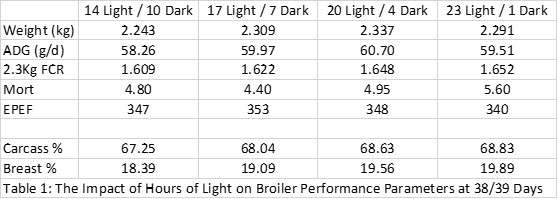
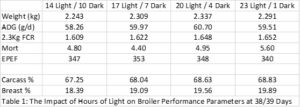
ตารางที่ 1: ผลกระทบของจำนวนชั่วโมงแสงต่อประสิทธิภาพการผลิตของไก่เนื้อที่อายุ 38/39 วัน
| เปิด 14 / ปิด 10 | เปิด 17 / ปิด 7 | เปิด 20 / ปิด 4 | เปิด 23 / ปิด 1 | |
| น้ำหนัก (กก.) | 2.243 | 2.309 | 2.337 | 2.291 |
| ADG (กรัม/วัน) | 58.26 | 59.97 | 60.70 | 59.51 |
| FCR ที่น้ำหนัก 2.3 กก. | 1.609 | 1.622 | 1.648 | 1.652 |
| อัตราการตาย (%) | 4.80 | 4.40 | 4.95 | 5.60 |
| EPEF | 347 | 353 | 348 | 340 |
| ซาก (%) | 67.25 | 68.04 | 68.63 | 68.83 |
| เนื้อหน้าอก (%) | 18.39 | 19.09 | 19.56 | 19.89 |
Appropriate lighting programs can optimize economic results and welfare of your broilers. Defined periods of light and dark create distinct routines for the birds to allow them to experience natural patterns of growth, development, and behavior, including sleep.
การใช้โปรแกรมแสงที่เหมาะสมสามารถเพิ่มผลตอบแทนทางเศรษฐกิจและยกระดับสวัสดิภาพของไก่เนื้อได้ การกำหนดช่วงเวลาที่เปิดและปิดแสงที่ชัดเจนจะช่วยสร้างกิจวัตรให้แก่ไก่ ทำให้มีการเจริญเติบโต พัฒนาการ และพฤติกรรมตามธรรมชาติ รวมถึงการนอนหลับด้วย
The essential components of any lighting program are the hours of light, the hours of darkness, the color (wavelength) of the light, and the light intensity.
องค์ประกอบสำคัญของโปรแกรมแสงประกอบด้วย: จำนวนชั่วโมงแสง จำนวนชั่วโมงที่ปิดแสง สีของแสง (ความยาวคลื่น) และความเข้มแสง
Simpler lighting programs tend to be easier to implement and yield in more consistent results. The “best” program for each flock will be influenced by several factors:
โปรแกรมแสงที่เรียบง่ายมักจะนำไปปฏิบัติได้ง่ายกว่าและให้ผลลัพธ์ที่สม่ำเสมอมากกว่า โดย “โปรแกรมที่ดีที่สุด” สำหรับไก่เนื้อแต่ละฝูงนั้นจะขึ้นอยู่กับปัจจัยหลายประการ:
- Age at program implementation – Early implementation of a program tends to benefit bird health the most.
- อายุที่เริ่มใช้โปรแกรม: การเริ่มใช้โปรแกรมตั้งแต่เนิ่น ๆ มักจะส่งผลดีต่อสุขภาพไก่มากที่สุด
- Processing Age – Older birds tend to benefit more from greater periods of darkness.
- อายุจับ: ไก่ที่เลี้ยงจนมีอายุมากมักจะได้รับประโยชน์จากช่วงเวลาที่ปิดแสงยาวนานขึ้น
- Growth rate – The impact of a lighting program will be greater in faster growing birds.
- อัตราการเจริญเติบโต: ผลกระทบของโปรแกรมแสงจะเห็นได้ชัดเจนขึ้นในไก่ที่มีอัตราการเจริญเติบโตเร็ว
- Equipment availability and management – Longer dark periods tend to result in greater eagerness to eat and drink when the lights come on, causing crowding at the feeders and drinkers.
- อุปกรณ์และการจัดการ: ชั่วโมงปิดแสงที่ยาวนานขึ้นอาจทำให้ไก่มีความกระตือรือร้นในการกินอาหารและน้ำมากขึ้นเมื่อเปิดไฟ ซึ่งอาจก่อให้เกิดการเบียดเสียดกันที่อุปกรณ์ให้อาหารและน้ำได้
Table 2. An example of a lighting program for broilers with a target weight of approximately 2 kilograms.
ตารางที่ 2: ตัวอย่างโปรแกรมการให้แสงสว่างสำหรับไก่เนื้อที่มีน้ำหนักเป้าหมายประมาณ 2 กิโลกรัม
| อายุ (วัน) | ชั่วโมงเปิดแสง | ชั่วโมงปิดแสง | ความเข้มของแสง (ลักซ์) |
| 0 | 23 | 1 | 30-40 ลักซ์ (การกกลูกไก่ทั้งโรงเรือน) / 80-100 ลักซ์ (การกกลูกไก่แบบใช้หัวกก) |
| 1 | 23 | 1 | 30-40 ลักซ์ |
| 2 | 23 | 1 | |
| 3 | 23 | 1 | |
| 4 | 22 | 2 | |
| 5 | 21 | 3 | |
| 6 | 20 | 4 | |
| 7 | 19 | 5 | 20-30 ลักซ์ |
| 8 | 19 | 5 | 10-20 ลักซ์ |
| 9 | 19 | 5 | 5-10 ลักซ์ |
| …. | 19 | 5 | |
| อายุก่อนจับ 4 วัน | 19 | 5 | |
| อายุก่อนจับ 3 วัน | 20 | 4 | |
| อายุก่อนจับ 2 วัน | 21 | 3 | |
| อายุก่อนจับ 1 วัน | 22 | 2 | |
| อายุจับ | 23 | 1 |
All local regulations regarding dark periods and light intensity must be followed and supersede any advice given here. A dark period must have a light intensity of <0.4lux. To test this, stand in the house with the lights off. Any observable light leakage should be fixed.
ต้องปฏิบัติตามกฎระเบียบท้องถิ่นทั้งหมดเกี่ยวกับช่วงเวลาให้แสงสว่างและความเข้มแสง และให้ถือว่ากฎระเบียบเหล่านั้นสำคัญกว่าคำแนะนำในที่นี้ ช่วงที่ปิดแสงต้องมีความเข้มแสงน้อยกว่า 0.4 ลักซ์ วิธีการทดสอบคือ ให้ยืนในโรงเรือนขณะที่ปิดไฟ หากมองเห็นจุดที่รั่วหรือมีแสงลอดผ่านควรทำการแก้ไขทันที
Changes to lighting programs should be gradual over a period of 2-3 days to help the birds adapt. Sudden changes in light duration can cause immediate drops in feed and water intake, resulting in reduced growth and health. Using a “dusk / dawn” program where lights are slowly turned on will result in birds gradually waking up and eating, avoiding overwhelming the feeding and drinking systems. Staggering the dark period between houses can help ensure that the farm’s drinking system is not overwhelmed when the lights come on.
การเปลี่ยนแปลงโปรแกรมแสงควรทำอย่างค่อยเป็นค่อยไปในช่วง 2-3 วันเพื่อให้ไก่ปรับตัว การเปลี่ยนระยะเวลาแสงอย่างกะทันหันอาจทำให้การกินอาหารและน้ำลดลงทันที ส่งผลกระทบต่อการเติบโตและสุขภาพ การใช้โปรแกรมแสง “เลียนแบบธรรมชาติ (dusk-to-dawn)” ซึ่งไฟจะค่อย ๆ สว่างขึ้น จะช่วยให้ไก่ทยอยตื่นและเริ่มกินอาหาร ช่วยลดปัญหาการแย่งกันใช้อุปกรณ์ให้อาหารและน้ำ นอกจากนี้ การเหลื่อมเวลาช่วงปิดแสงระหว่างโรงเรือนในฟาร์มเดียวกัน ยังช่วยป้องกันไม่ให้ระบบจ่ายน้ำของฟาร์มทำงานหนักเกินไปเมื่อเปิดไฟพร้อมกัน
Using an intermittent lighting program in which the dark period is split into two or more parts can result in an increased growth rate. These programs should be kept simple to allow for effective implementation. A dark period of at least 4 hours in any given 24-hour period is recommended and all local regulations must be followed.
การใช้โปรแกรมแสงเป็นระยะ (Intermittent Lighting Program) โดยแบ่งช่วงปิดแสงเป็น 2 ส่วนหรือมากกว่า สามารถช่วยเพิ่มอัตราการเจริญเติบโตได้ อย่างไรก็ตามควรออกแบบโปรแกรมให้เรียบง่ายเพื่อให้เกิดประสิทธิภาพในการปฏิบัติงาน แนะนำว่าควรมีช่วงปิดแสงอย่างน้อย 4 ชั่วโมงในรอบ 24 ชั่วโมง และต้องปฏิบัติตามกฎระเบียบในพื้นที่อย่างเคร่งครัด
Birds see within a different set of wavelengths compared to humans, and have light receptors both in their eyes and within the brain. Birds see much more effectively in the UV spectrum and, therefore, gallilux rather than lux should be used to measure light intensity for chickens. Most agricultural light meters have instructions to convert from one unit to the other, or a specialist gallilux meter can be purchased. Note that standard lux meters do not effectively measure LED light because of the high blue content of LED light. A specialized LED lux meter should be used for the best accuracy with these bulbs.
ไก่มีการมองเห็นในช่วงความยาวคลื่นที่แตกต่างจากมนุษย์ และมีตัวรับแสงทั้งในดวงตาและในสมอง ไก่สามารถมองเห็นในรังสี UV ได้ดีมาก ดังนั้นจึงควรใช้หน่วย “กัลลิลักซ์” (Gallilux) แทนหน่วย “ลักซ์” (Lux) ในการวัดความเข้มแสงสำหรับไก่ เครื่องวัดแสงทางการเกษตรส่วนใหญ่จะมีคำแนะนำในการแปลงหน่วย หรือสามารถซื้อเครื่องวัดกัลลิลักซ์โดยเฉพาะได้ ทั้งนี้ เครื่องวัดลักซ์มาตรฐานไม่สามารถวัดแสงจากหลอด LED ได้อย่างแม่นยำเนื่องจากมีส่วนประกอบของแสงสีฟ้าสูง จึงควรใช้เครื่องวัดลักซ์สำหรับ LED โดยเฉพาะเพื่อให้ได้ค่าที่ถูกต้องที่สุด
Light intensity must be evenly distributed across the house to avoid localized points of high stocking density. The difference in intensity from the lightest to the darkest part of the house should be no more than 30%. Ensure that light bulbs are evenly placed throughout the house, that all bulbs are matched, and that broken bulbs are replaced promptly.
การกระจายของความเข้มแสงต้องสม่ำเสมอตลอดทั้งโรงเรือน เพื่อหลีกเลี่ยงการรวมกลุ่มกันของไก่ในจุดใดจุดหนึ่ง ความแตกต่างของความเข้มแสงระหว่างจุดที่สว่างที่สุดและมืดที่สุดไม่ควรเกิน 30% ควรตรวจสอบให้แน่ใจว่าหลอดไฟติดตั้งในตำแหน่งที่เหมาะสม เป็นรุ่นเดียวกันทั้งหมด และเปลี่ยนหลอดที่เสียทันที
The warmth (or color temperature) of lights is measured in Kelvins (K). Smaller birds tend to perform better in cool colors, whereas larger birds require warmer colors. For a flock with a target weight of <2kg, 5,000-6,000K is recommended, for >2kg birds, 3,500-4,500K is advised.
อุณหภูมิสีของแสงวัดเป็นหน่วยเคลวิน (K) ไก่ขนาดเล็กมักจะให้ผลผลิตดีในแสงโทนเย็นที่มีค่า K สูง ในขณะที่ไก่ขนาดใหญ่ต้องการแสงโทนอุ่น ค่า K ต่ำ แนะนำ 5,000-6,000K สำหรับน้ำหนักเป้าหมาย <2 กก. และแนะนำ 3,500-4,500K สำหรับน้ำหนักเป้าหมาย >2 กก.
There is little clear evidence of the impact of light color on broiler performance. With the increase in availability of LED lights, color is now much easier to control. Blue or green wavelengths (450-560nm) tend to promote calmness, improving FCR, leg health, and livability, while reducing downgrades. The red end of the spectrum (>620nm) appears to promote broiler growth.
ยังไม่มีหลักฐานแน่ชัดเกี่ยวกับผลกระทบของสีแสงต่อประสิทธิภาพของไก่เนื้อ แต่เมื่อหลอด LED แพร่หลายมากขึ้น การควบคุมสีก็ทำได้ง่ายขึ้น แสงความยาวคลื่นสีน้ำเงินหรือเขียว (450-560 นาโนเมตร) มีแนวโน้มช่วยให้ไก่สงบ ปรับปรุงค่า FCR สุขภาพขา และอัตราการรอดชีวิต รวมถึงลดการเกิดซากตกเกรด ส่วนแสงในย่านสีแดง (>620 นาโนเมตร) มีส่วนช่วยส่งเสริมการเจริญเติบโต
The type of lamp used does not appear to affect bird performance, as long as it produces white light, so the choice of bulb is largely determined by cost and availability. Birds have a high ability to see flicker, and this results in stress, leading to a reduction in expected behaviors. High-frequency (>200 Hz), fluorescent or LED lights should be used to avoid detectable flicker. Domestic LED bulbs are generally not robust enough to cope with conditions in the poultry house and should be avoided.
ประเภทของหลอดไฟที่ใช้ดูเหมือนจะไม่ส่งผลต่อประสิทธิภาพตราบเท่าที่ให้แสงสีขาว ดังนั้นการเลือกใช้จึงขึ้นอยู่กับต้นทุนและความพร้อมในตลาด อย่างไรก็ตาม ไก่มีความสามารถสูงในการมองเห็นการกระพริบของแสง (Flicker) ซึ่งทำให้เกิดความเครียดและพฤติกรรมตามธรรมชาติลดลง จึงควรใช้หลอดฟลูออเรสเซนต์ความถี่สูง (>200 Hz) หรือหลอด LED เพื่อหลีกเลี่ยงปัญหานี้ ทั้งนี้ หลอด LED เกรดใช้งานทั่วไปในบ้านมักไม่ทนทานพอสำหรับสภาพแวดล้อมในโรงเรือนไก่ จึงควรหลีกเลี่ยง
During hot weather, if environmental control is limited, the dark period should be timed to maximize bird comfort. The dark period, therefore, should be overnight. Research from Aviagen indicates that each broiler spends only about 90 minutes a day eating and drinking. Even with relatively short light periods, provided that the appropriate amount of feeding and drinking equipment is available, all birds should have ample time to eat and drink.
ในช่วงที่มีอากาศร้อน หากระบบควบคุมสภาพแวดล้อมมีจำกัด ควรตั้งเวลาปิดแสงภายในโรงเรือนให้ตรงกับช่วงที่ไก่สบายที่สุด ซึ่งก็คือช่วงกลางคืน จากการวิจัยของ Aviagen พบว่าไก่เนื้อแต่ละตัวใช้เวลาเพียงประมาณ 90 นาทีต่อวันในการกินอาหารและน้ำ ดังนั้น แม้ชั่วโมงการเปิดแสงจะสั้นลง แต่หากบริหารจัดการจำนวนอุปกรณ์ให้เหมาะสม ไก่จะยังคงสามารถเข้าถึงอาหารและน้ำได้อย่างทั่วถึงและเพียงพอ
The use of lighting programs is a simple and inexpensive way to improve bird health, welfare, and performance. For more information on broiler lighting, visit the Aviagen Info Center at www.aviagen.com or click on the QR code.
การใช้โปรแกรมแสงเป็นวิธีที่ง่ายและประหยัดในการปรับปรุงสุขภาพ สวัสดิภาพ และประสิทธิภาพการผลิตของไก่เนื้อ ท่านสามารถค้นหาข้อมูลเพิ่มเติมได้ที่ Aviagen Info Center เว็บไซต์ www.aviagen.com หรือสแกนรหัส QR